
Why Dog Training Is One of the Most Emotionally Demanding Jobs Nobody Talks About
Jul 28, 2026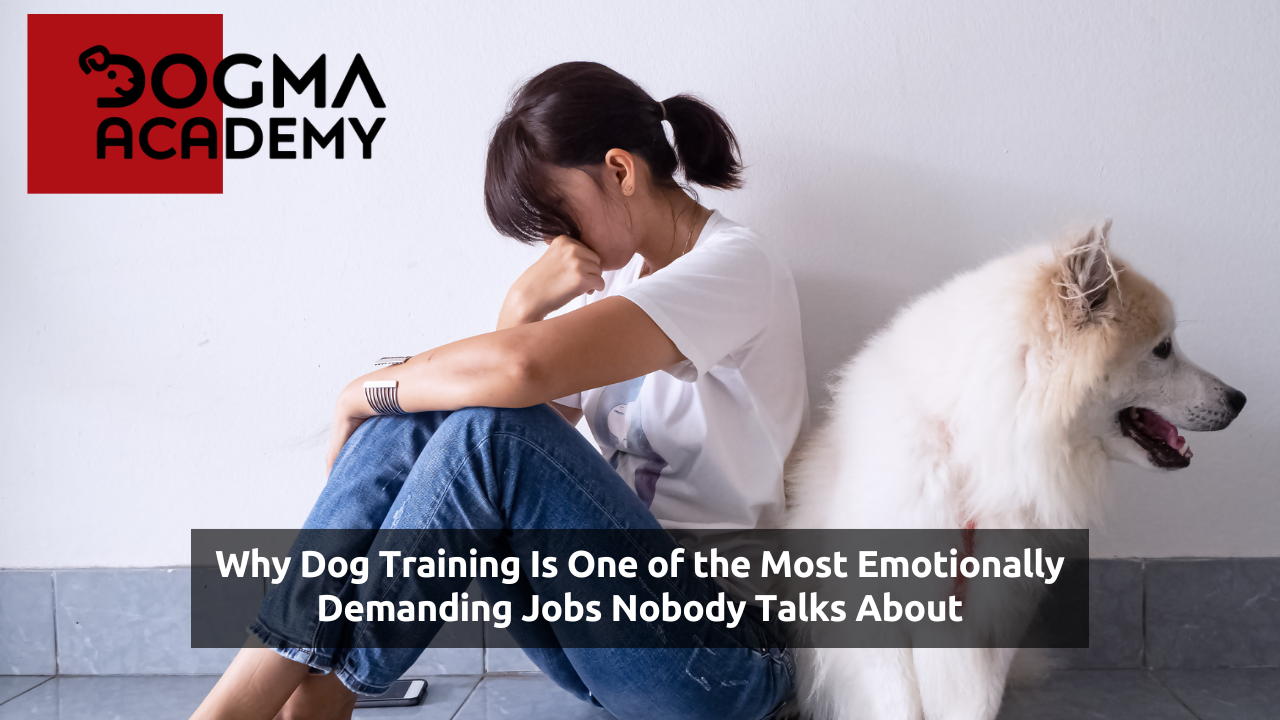
Ask someone outside the industry what dog trainers do, and they'll probably picture a cheerful professional teaching dogs to sit, stay, and walk nicely on a leash. Or some picture them playing with puppies. It looks like a dream job. Spend your days with dogs, help some families out, go home happy.
It is a dream job, but it is also one of the most emotionally demanding careers you can choose, and almost nobody warns you about that part before you're already in it.
This post is for the trainers who are feeling the weight of it - whether you're in your first year and wondering if something is wrong with you, or you're a seasoned professional quietly running on fumes. You're not alone, you're not failing, and what you're carrying is real.
You're Holding Space for a Lot of People's Pain
Clients rarely come to us when things are going well. They come when they're overwhelmed, embarrassed, scared, or at the end of their rope. They come after months of struggling alone and after relationships have been strained by a dog whose behaviour they don’t know how to manage.
By the time they sit across from you, they're carrying a lot. And because you care, because caring is part of what makes you good at this work, you absorb some of that weight. This repeats session after session, client after client, day after day.
This is called compassion fatigue, and it's a known occupational hazard in our profession. It doesn't mean you're too sensitive. It means you're doing emotionally engaged work without always having a space to decompress afterward. Over time, that accumulates in ways that aren't always obvious until you're already depleted.
The Cases Stay With You
Most professions have a natural boundary between work and home. Dog training often doesn't. The reactive dog you worked with today, the family who is barely holding it together, the case where you're not sure the outcome is going to be okay - these don't clock out when you do.
Trainers who work with fear, anxiety, and aggression cases carry a particular kind of weight. These are complex, often slow-moving cases where the stakes feel high and the margin for error feels narrow. The dog's welfare, the family's well-being, and everyone’s safety are all weighing on you.
It is normal to think about your cases after hours and to lose a little sleep over a hard one. What isn't sustainable is carrying all of it alone, without a space to process it or a community to help you think it through. Our friends and family outside of this industry do not fully understand the weight of this work.
You Care About Outcomes You Can't Fully Control
One of the harder truths of this profession is that you can do everything right and still not get the outcome you were hoping for. Perhaps a family doesn't follow through, a dog's anxiety is more complex than the initial assessment suggested, resources run out before progress is made, or life intervenes.
For trainers who are deeply invested in the animals they work with, which is most of us, this is difficult. We didn't get into this work to witness dogs and families struggle. We got into it to help. And when helping isn't enough, or isn't possible, that gap between intention and outcome takes a toll.
Learning to hold your own effort and integrity separate from the outcome is one of the most important, and most challenging, professional skills in this field. You are responsible for the quality of your work. You are not responsible for every variable beyond it.
The Industry Itself Can Be Isolating
Most dog trainers work alone. You run your own schedule, manage your own clients, and spend the majority of your working hours without a colleague in the room. There's no team debrief at the end of the day, no manager to flag a hard case to, no built-in peer support.
Layer onto that the reality that our industry is still largely unregulated, which means the professional landscape can feel fragmented and sometimes combative. Trainers who are committed to ethical, evidence-based practice can find themselves navigating an environment that doesn't always reward those values, and that adds its own kind of exhaustion.
Isolation amplifies everything. The hard cases feel harder. The self-doubt feels louder. The wins feel quieter because there's nobody around to share them with. This is why community isn't a nice-to-have in this profession, it is a must and a protective layer.
Here's What Helps
Acknowledging the emotional weight of this work is the first step. The second is building the habits and structures that help you carry it sustainably. Here's what actually makes a difference:
- Find your people. A community of trainers who share your values and understand the specific demands of this work is one of the most protective things you can invest in. Not just for professional development but for your mental health.
- Use mentorship. Bringing a hard case to an experienced mentor isn't a sign of a lack of skills; it's a sign of professional maturity. The trainers who ask for help are consistently the ones who grow fastest and burn out least.
- Build decompression into your schedule. What happens after a hard session matters. A walk, a quiet activity, a conversation with someone who gets it. These aren't luxuries; they're part of doing this work long-term.
- Set boundaries early and revisit them often. The clients you take on, the hours you work, the cases you accept, are all decisions that shape your sustainability. Boundaries aren't about caring less. They're about being able to keep caring.
- Celebrate the wins out loud and with someone. Progress in this field can be slow and incremental. If you don't actively acknowledge what's working, it's easy to only ever feel the weight of what isn't.
This Work Is Worth It And So Are You
None of this is written to discourage you. It's written because the trainers who last in this industry and the ones who build meaningful, sustainable careers are the ones who take their own wellbeing as seriously as they take their clients'.
The emotional demands of dog training, the compassion fatigue, and the isolation are real. And so is the privilege of doing work that truly changes lives for dogs, for families, and for the communities we're all part of.
You got into this because you care deeply. Don't let the weight of that caring push you out of a profession that needs people exactly like you in it.
At Dogma Academy, we talk openly about the emotional side of this work because we believe it's inseparable from professional development. Our graduates have lifetime access to mentor hours, social hours, guest speakers, and dedicated self-care sessions, because we know that a supported trainer is a better trainer, and that the long game in this profession requires more than just skill.
If you're feeling the weight of it right now, we see you. And there's a place
